MSMEs are at the heart of India’s economic engine—and they also hold the key to achieving the nation’s ambitious climate goals. However, there’s an undeniable gap in green financing reaching MSMEs. Kinara Capital, a leading fintech driving MSME financial inclusion, conducted customer surveys to deep dive into the issue of small businesses not accessing green financing with its 5th edition of MSME Insights. MSMEs are severely underserved in terms of accessing formal credit, and the scenario is just as dire when it comes to green financing. The survey, conducted with 3,649 MSMEs across 100+ cities and multiple sectors, revealed both the challenges and the potential of the sector to drive India’s climate-positive transformation. Kinara has been furthering its mission to provide discounted Green Business Loans without property collateral exclusively to India’s micro-small-medium enterprises (MSMEs) involved in the manufacturing or trading of eco-friendly products. In doing so, the company is broadening access and promoting awareness within the MSME sector.
Indian MSMEs alone account for approximately 3-4% of India’s total emissions, or about 110 million tonnes of CO2 equivalent annually. And 65% of MSMEs cite lack of capital availability as a major barrier to adopting sustainable practices. At a macro level, India requires nearly $2.5 trillion in green finance by 2030 to meet its climate goals, but current inflows cover only one-third of this demand. This leaves a $1.6 trillion shortfall, underscoring the urgent need for private capital and innovative financing solutions. Yet, when it comes to the country’s green transition, MSMEs often face an uphill battle, particularly due to lack of access to capital and information. Here’s a look at what Kinara Capital’s MSME Insights revealed about the green financing gap among Indian MSMEs.
Awareness Gap, Not Intent, is the Real Barrier
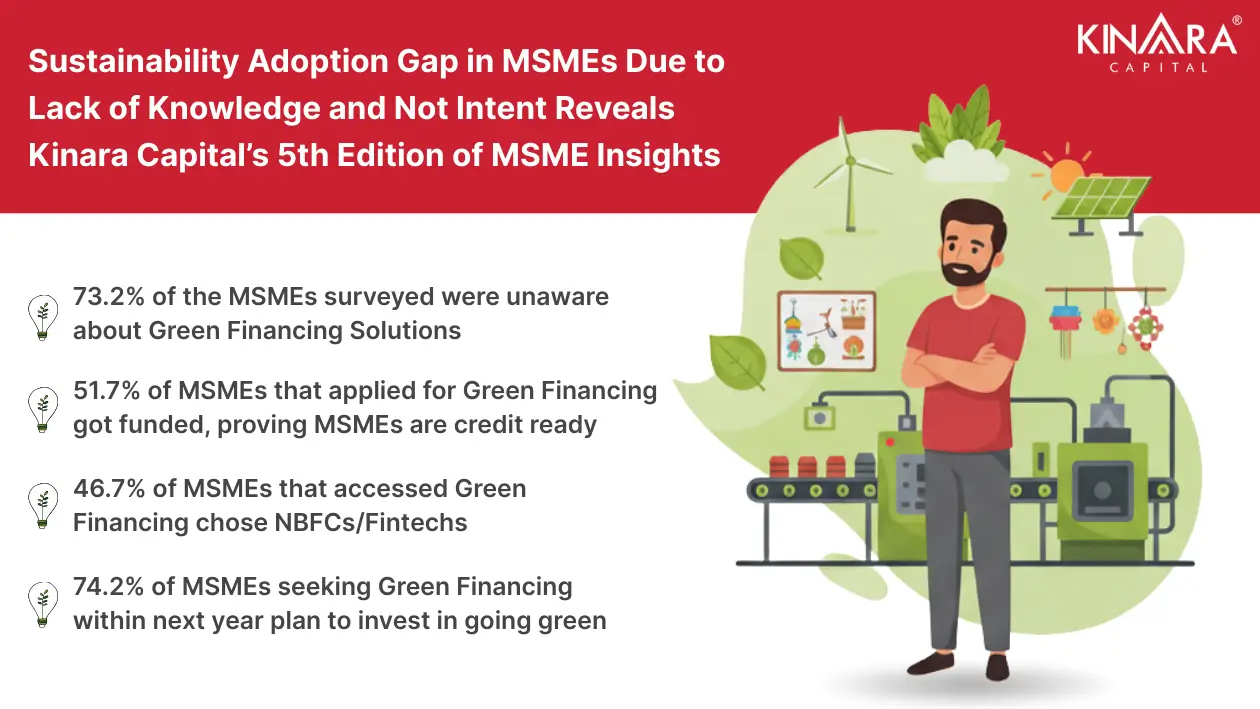
One consistent barrier that comes when looking at what keeps MSMEs from accessing services and benefits is the lack of awareness, and green financing is no exception to this. Of the 3,649 MSMEs surveyed across 100+ cities in the 5th edition of MSME Insights, nearly 3 out of 4 (73.2%) reported being unaware of available Green Financing solutions. Even among those who were aware, 11.2% said uncertainty around the application process stopped them from applying. Yet more than half (51.7%) of MSMEs who applied were successful in receiving financing, showing that eligibility is not the obstacle.
Interestingly, the survey also showed that incentives neither drive nor deter green adoption. Only 3.7% of MSMEs cited incentives as a reason for not adopting green finance, underscoring once again that the real challenge is awareness, not motivation to adopt these solutions.
NBFCs and Fintechs Emerge as Preferred Partners
When accessing green financing, MSMEs are increasingly turning to newer, flexible lenders. Nearly half (46.7%) chose NBFCs or fintechs, compared to 24.1% who approached private banks and 17.5% who went to nationalized banks. This shift highlights MSMEs’ preference for technology-driven, customized lending solutions. Embedded finance options are also playing a role in making credit more accessible and timely.
High Intent to Go Green Across Cities and Sectors
Despite low awareness, the intent to adopt green practices is strong among small businesses, which is heartening in the context of the nation’s green targets and the major role of MSMEs in achieving them. The survey showed that among MSMEs planning to take business financing in the next year, 74.2% intend to use it to make their operations more sustainable. Beyond their own businesses, 14% plan to manufacture eco-friendly products, while 11.8% plan to sell them directly to consumers. This bodes well for the sustainability ecosystem that is emerging in the country, with more end-users seeking out eco-friendly products. With MSMEs accessing and utilizing green financing, the ecosystem can be further strengthened and expanded, leading to acceleration of the green transition.
Grow your MSME with collateral-free business loans
What Green Solutions MSMEs Want
The survey revealed that MSMEs are considering a diverse set of green solutions. Interest is highest in rooftop solar and solar-powered products (32.4%), followed by electric vehicles (27.7%), energy-efficient machinery (19.3%), and WaSH solutions for sanitation, water, and waste management (11.2%). Nearly a quarter (24.9%) of MSMEs are exploring more than one solution, reflecting a dual motivation to cut costs and meet sustainability goals.
All of these form significant elements of the sustainability ecosystem, and it is a positive sign that there is strong awareness and intent to incorporate them among a section of MSMEs.
Trading MSMEs Lead in Green Intent
Trading MSMEs are ahead of manufacturing businesses in their readiness to adopt Green Financing. More than 55% of trading businesses expressed interest in availing Green Loans for their operations, compared to 41% of manufacturing MSMEs. Among trading MSMEs, consumables-related businesses such as general stores, healthcare and personal care shops, and medical outlets led at 30.6%.
These were followed by B2B sub-sectors like automobiles, industrial products, and machine components (19.9%), and textile and apparel traders (19.8%). Manufacturing MSMEs showed strong interest in metal-related sub-sectors such as fabrication, machine components, and auto parts, which together accounted for 37.8% of responses.
Tamil Nadu and Andhra Pradesh MSMEs Show the Way
The survey also found that regionally, the southern states are leading the green transition. Tamil Nadu and Puducherry MSMEs ranked highest with 37.5% expressing intent to adopt green practices. Andhra Pradesh and Telangana followed at 31.6%, with Karnataka at 22.1%. Together, Gujarat and Maharashtra accounted for 8.8%.
As the nation progresses towards large-scale uptake of green solutions to meet its ambitious climate goals, this would call for more impetus to drive awareness in other regions.
The Road Ahead
The 5th edition of MSME Insights makes one fact clear: MSMEs are motivated and willing to be active participants in India’s climate goals, but they need awareness, guidance, and accessible financing. With 74% planning to invest in greener operations, the intent is strong. The challenge is bridging the knowledge and credit access gap. Kinara Capital’s research and solutions point the way forward: making green financing a mainstream driver of both MSME growth and climate action.
FAQs
1. What is the MSME Insights report by Kinara Capital?
MSME Insights is Kinara Capital’s research initiative to better understand the challenges and opportunities for India’s micro, small, and medium enterprises (MSMEs). The 5th edition focused on Green Financing, surveying 3,649 MSMEs across 100+ cities and multiple sectors to gauge awareness, intent, barriers, and potential.
2. What did the survey reveal about MSMEs and green adoption?
The survey revealed that the biggest barrier is awareness. Nearly 73% of MSMEs are unaware or lack clarity about Green Financing options, yet intent to go green is very high. Among those planning to borrow in the next year, 74% intend to invest in sustainable practices.
3. Why does Green Financing matter for India’s future?
India requires $2.5 trillion in climate financing by 2030, but only a third of that is currently being met. MSMEs are central to bridging this gap. By providing awareness, access, and tailored loan products, fintech NBFCs like Kinara Capital can help MSMEs become powerful drivers of the country’s Net Zero journey.
4. What kinds of green solutions can MSMEs implement?
MSMEs can implement a variety of green solutions in their operation, depending on the type of business and sector or sub-sector they operate in. In the survey, MSMEs expressed demand for rooftop solar, electric vehicles, energy-efficient machinery, and WaSH solutions. Many are exploring more than one solution, showing both intent to reduce costs and a commitment to sustainable growth.
5. How can MSMEs access Green Financing?
For many MSMEs, the biggest hurdle to implementing green solutions is accessing the financing for it. New-age fintech NBFCs like Kinara Capital simplify the process by offering fast and easy Green Loans on platforms where MSMEs need them through embedded finance.
6. How is Kinara Capital supporting MSMEs looking to make the green transition?
To support MSMEs in accessing financing to strengthen the sustainability ecosystem in the country, Kinara offers Green Loans of ₹50,000 to ₹30 lakhs with discounted interest rates. The loans are easily applied for, approved, and disbursed within 24-hours. Kinara supports MSMEs across the green ecosystem, from natural materials and recycling to sanitation equipment and water filtration.
About the Author